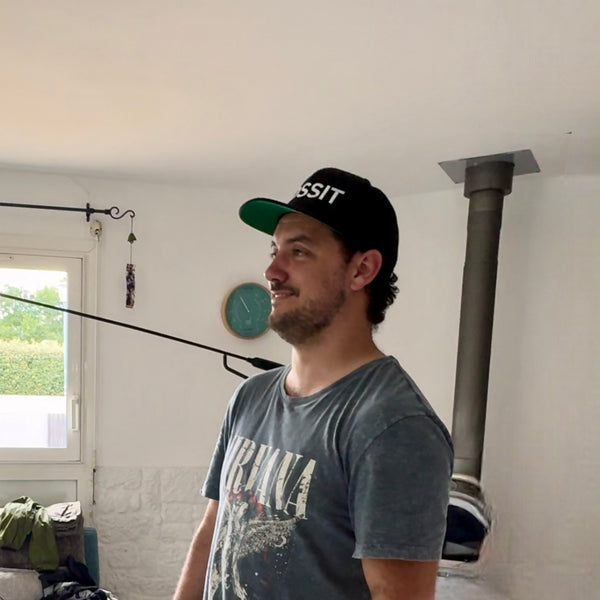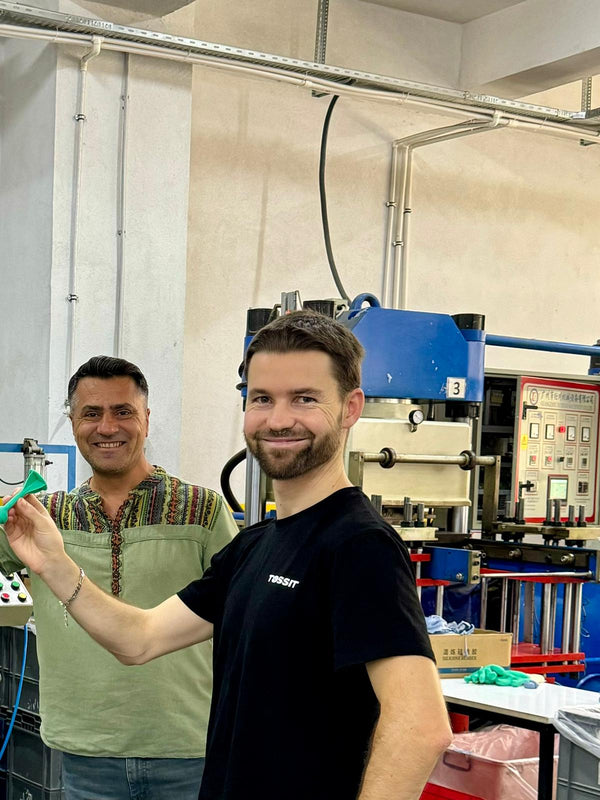
Gaetan Ekszterowicz
Engineer. Designed the dart.
The engineer behind the dart itself — the front-weighting, the wings that kill the wobble, the 40mm silicone cup. Twelve-plus 3D-printed prototypes before one of them stuck properly.

Two brothers, a locked-down Paris apartment, and a stubborn idea: that a grown adult and an eight-year-old should be able to play the same game and both actually want to win. This is everyone who has had a hand in it since.

Engineer. Designed the dart.
The engineer behind the dart itself — the front-weighting, the wings that kill the wobble, the 40mm silicone cup. Twelve-plus 3D-printed prototypes before one of them stuck properly.


Gaetan's brother, and the other half of the beginning.
Bio still being written. They are busy throwing things.
France
Runs Tossit in the United States.
Bio still being written. They are busy throwing things.
Las Vegas, NV
Bio still being written. They are busy throwing things.
Würzburg, Germany
Bio still being written. They are busy throwing things.
Magny-en-Vexin, France
Bio still being written. They are busy throwing things.
Madrid, Spain
Bio still being written. They are busy throwing things.
Paris, France
Bio still being written. They are busy throwing things.
Turin, ItalyBio still being written. They are busy throwing things.
Belgrade, SerbiaBio still being written. They are busy throwing things.
Buenos Aires, ArgentinaIt began on a gravel pétanque court and ended up on a 3D printer. The short version, in the founders' own order of events.
Gaetan and Nicolas Ekszterowicz grew up throwing things — mostly pétanque, the French cousin of bocce, played on gravel with a drink in the other hand. When the world shut down they ended up in a bare Paris office with a 3D printer and more time than sense, sleeping on the floor between iterations.
What bothered them was not a lack of games. It was that parents and kids were never playing the same one. Adult games are too slow for a nine-year-old. Kids' games make adults feel ridiculous. They wanted one board where a grown-up could genuinely try to win and not look silly doing it.
The shape got argued out on paper first, then in CAD — every version measured against the same question: does it fly straight enough that a beginner's first throw sticks?
Roughly a dozen designs came and went — printed, thrown at a wall, thrown out. The survivor is front-weighted so it stops tumbling, carries small wings instead of a smooth tube so it stops drifting, and lands on a 40mm silicone cup soft enough to seal against glass.
The wings were the turning point. A smooth body rolled in the air and landed however it felt like; a winged one holds its line and arrives cup-first, which is the difference between a dart that sticks and a dart that bounces.
The dart is still designed in France — that photo is the brothers at their first trade show in Cannes. The US side runs out of Las Vegas as Bocce Darts LLC, a name that gives away exactly which gravel-court game started all of this.
The target, the scoring, the argument about whose turn it is.
Knocking someone else's shot out of the way, which is most of the fun.
The gravel-court original: throw, land close, talk trash, repeat.
One set, a wall, and about four seconds of instruction. That is the whole barrier to entry, and it always was.